
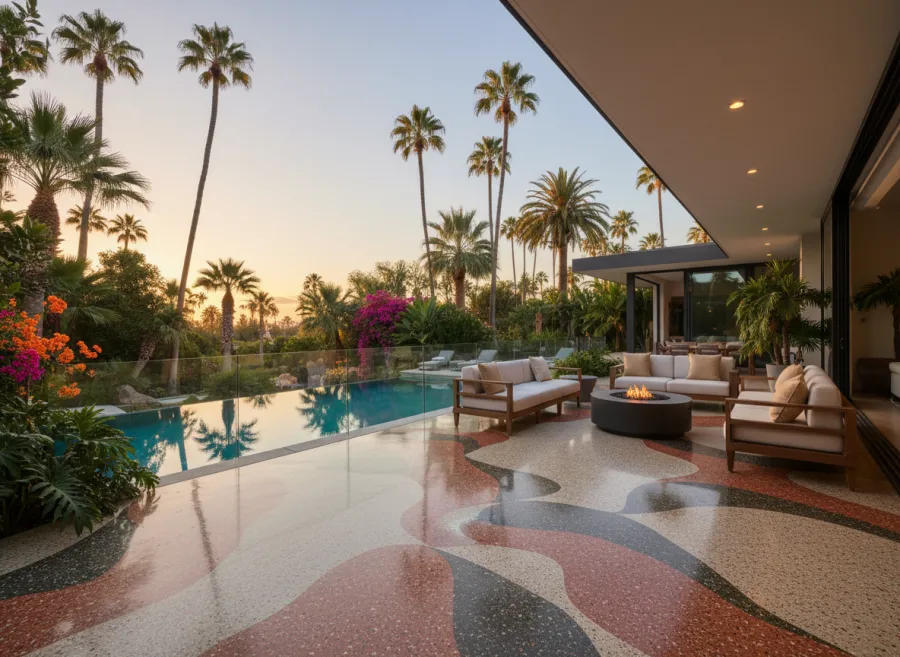
Is epoxy good for a Florida pool deck?
Epoxy belongs on a Florida pool deck only as the base layer, never as the finish. Standard epoxy yellows and chalks in direct sun, so the system that actually works outdoors is an epoxy or polyurea base coat, UV-rated flake broadcast to full coverage, and a UV-stable polyaspartic topcoat. Installed Florida pricing for that class of system runs about $8 to $14 per square foot.
Pool decks, lanais, and walkways are a big share of what we coat at Apex, and this question comes up on almost every quote. Here is the straight version: why bare epoxy fails outside, what the working pool deck coating system looks like, what it costs in Florida, and how long it holds up.
Why does bare epoxy fail in the sun?
The failure is chemistry, and it has been measured. Epoxy resins are built on an aromatic ring structure that absorbs UV, so the coating yellows and loses gloss under sunlight. A 2024 technical article in CoatingsTech, the American Coatings Association’s journal, put standard epoxy through a 500-hour accelerated weathering test: it yellowed sharply and kept as little as 12 percent of its gloss, while an aliphatic polyurethane clear coat in the same test barely changed at all.
Coating manufacturers design around this rather than deny it. Sherwin-Williams sells a dedicated UV-stable resin line marketed on the promise that it “helps keep floors from yellowing over time,” and flake manufacturer Torginol makes a UV-rated flake specifically for outdoor work, with BASF light stabilizers, tested to hold its color through a 1,000-hour xenon-arc sun test. Torginol’s own datasheet tells installers to pair it with “color stable and weather resistant coatings.”
One honest exception: under a fully shaded or screened area, plain epoxy can be acceptable. Open Florida decks get no such mercy.
What system actually works on a pool deck?
The build we install is three layers doing three jobs. A moisture-tolerant epoxy or polyurea base coat bonds to the ground, repaired concrete. Vinyl flake, in a UV-rated blend, is broadcast into the wet base to full coverage. Then an aliphatic polyaspartic topcoat goes over everything, and that layer is what faces the sun, the chlorine splash, and the foot traffic. Full detail on the flake layer is in our guide to full-broadcast flake flooring.
Compared to the other common Florida deck options:
| Option | Florida installed cost | Typical lifespan | Trade-off |
|---|---|---|---|
| Flake system + polyaspartic topcoat | $8–$14/sq ft | 10–15 yrs | Highest coating tier, pro install only |
| Acrylic “cool deck” texture | $4–$9/sq ft | 5–8 yrs | Needs resealing every 2–4 yrs |
| Pavers | $10–$40/sq ft | Decades | Run hot, shift, need borders and sealing |
| Sealed plain concrete | $1–$3/sq ft | 1–3 yrs per seal | Cheapest, but bare gray runs hottest |
Acrylic cool-deck finishes deserve a fair word: they are a legitimate budget choice and genuinely comfortable barefoot. The trade is maintenance. Southwest Florida installers put them at a reseal every two to four years, against a 10-to-12-year recoat cycle for polyaspartic systems.
On temperature: you will see claims that this or that coating runs “20 degrees cooler.” Treat every degree figure as marketing, because the manufacturers themselves publish no measurements. What holds up is simpler: lighter colors absorb less heat, and texture means less of your foot contacts the surface at once. Pick a light flake blend for an open Florida deck.
How does a coated deck stay grippy when wet?
Flake texture is mechanical, not painted on. The overlapping chips cure into the coating as tiny ridges and valleys, so the grip is part of the floor itself rather than a grit that washes away. Where more traction is needed, texture additives go into the topcoat, and for barefoot areas installers use finer polymer additives instead of harsh aluminum oxide grit.
There is a real standard to ask about: ANSI A326.3 sets a minimum wet coefficient of friction of 0.55 for exterior surfaces. A deck coating quote for a Florida pool should be able to say how the finished texture gets there. Fair disclosure, straight from the standard’s own text: it compares surfaces, it does not promise nobody will ever slip. Around water, we tune grip on the aggressive side.
What does a pool deck coating cost in Florida?
Florida cost guides put decorative deck resurfacing and coating between $4 and $14 per square foot depending on system, with a 400 square foot deck landing between $1,600 and $6,000 all-in. Flake-plus-polyaspartic systems sit at the top of that band, spray textures at the bottom, and coastal counties pay a 15 to 20 percent premium for marine-grade materials. Tampa-area work tends to price above inland Florida for the same overlay.
For scale, resurfacing an existing deck runs a fraction of replacement: published figures put overlay work at $3 to $5 per square foot against $6 to $10 and up for new poured concrete, and full tear-out-and-replace at three to four times resurfacing cost. If the slab underneath is sound, coating it is the money-smart path.
Those are market ranges, not our price list. Deck quotes swing on slab condition, drainage, square footage, and the finish, so we look first and quote after. Quotes are free, and the garage floor version of the cost math works the same way if you are pricing both.
How long does it last here, and what about storms?
Florida installers rate polyaspartic-topped deck systems at 10 to 15 years, with South Florida guides citing 8 to 12 years before recoat on open decks. Screened lanais do better: one Florida cost guide puts coating life 25 to 40 percent longer under a screen, since it blocks a chunk of the UV and most direct rain. Maintenance is a broom and an occasional low-pressure wash.
Storm season is part of deck ownership here. A deck that sat under salt surge should be assessed before recoating, because salt soaks into concrete pores and can wreck a coating applied over it. That check became standard practice in the counties hit by recent hurricanes. The flip side is the reason so many coated decks get specified during rebuilds: a sealed, non-porous surface hoses clean after a storm instead of drinking in whatever the water left behind.
If your patio, lanai, or pool deck is due, look at the patio and pool deck coatings we install across Tampa Bay, then request a free quote or call (727) 423-5985. We are happy to talk through flake blends, grip levels, and whether your slab is a coating candidate before you spend anything.