
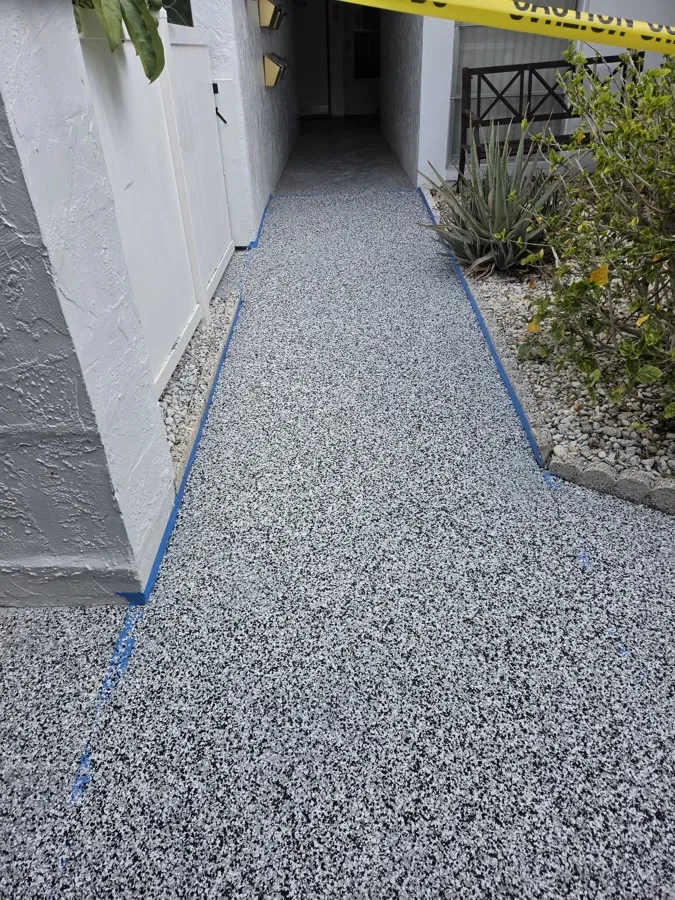
What is flake epoxy flooring, and why does full broadcast matter?
A flake epoxy floor is a layered system: a pigmented base coat rolled onto ground concrete, vinyl color flakes broadcast into it while wet, then one or two clear topcoats that lock the flake in and take the wear. “Full broadcast” means the flake covers 100 percent of the surface, which uses several times more material than a light scatter and is what separates a 15-to-20-year floor from a shorter-lived one.
Flake is what we install more than anything else at Apex, from garages to the condo walkway in the photo above, which is our own work here in Pinellas County. It is also the finish where quotes vary the most, because two bids that both say “flake epoxy” can describe very different floors. Here is the whole picture, including the part low bids leave out. If you already know you want one, our flake system flooring page covers what we install.
How is a flake floor actually built?
Torginol, the manufacturer that makes most of the flake used in this industry, diagrams the system in four layers: concrete, primer or base coat, the flake broadcast, and a clear topcoat, with the note that a clear coat is recommended to “fully encapsulate the flake and provide a durable wearing surface.”
On the job that looks like this. The slab gets diamond-ground and repaired. A pigmented base coat goes down, and while it is wet, the installer throws flake into it, then lets it cure. Everything loose gets scraped and vacuumed off, and the clear coats go over the top. Premium systems get two.
The flakes themselves are thin chips of pigmented vinyl, about 5 mils thick, made in over 150 colors and six sizes from 1/32 inch up to 1 inch. Quarter inch is the most popular. Most floors use a blend of two or three sizes and colors, which is how you get finishes that read as granite or terrazzo rather than confetti.
What does full broadcast actually mean?
Full broadcast, sometimes called broadcast to rejection, means flake is thrown until the wet base coat cannot hold any more and the base color disappears completely. A light or partial broadcast scatters flake at maybe 10 to 30 percent coverage and lets the base show through.
The material difference is bigger than most homeowners expect. Torginol’s own coverage table puts full coverage at 5 to 7 square feet per pound of flake, against 50 to 200 square feet per pound for a light scatter. Installer math for a two-car garage runs to roughly 100 pounds of flake for a true full broadcast. A light scatter of the same garage uses a few pounds.
| Full broadcast | Light / partial scatter | |
|---|---|---|
| Coverage | 100%, base coat invisible | 10–30%, base shows through |
| Flake used (2-car garage) | ~100 lbs | A few lbs |
| Structure | Base + full flake layer + topcoats | Thin coat with decoration |
| Typical lifespan | 15–20 years | 8–10 years |
| Price | Higher (more material + an extra clear coat) | Lower |
That table is also why full broadcast costs more: several times the flake, an extra clear coat, and more labor in the scrape-and-vacuum step. Industry guides warn specifically about “confetti” scatters sold at full-broadcast prices. If two quotes are far apart, ask each installer how many pounds of flake and how many clear coats are in the number. The cheap bid usually gets quiet.
What does flake actually do for the floor?
Three practical things, beyond looks. First, grip: the overlapping flakes create a light orange-peel texture that adds slip resistance, and the grip level can be tuned further with additives in the topcoat, from gentle polymer beads to aggressive grit for wet areas. Second, camouflage: the multi-tone blend hides dust, dirt, and minor slab imperfections better than any solid color, which is why flake garages look clean between sweepings. Third, thickness: a full broadcast adds a real material layer, so the finished system is simply more floor than a paint-thin coating.
Fair downsides: a flake floor costs 20 to 30 percent more than plain solid color, the texture takes slightly more effort to mop, and if you run a workshop where you drop tiny screws, a busy pattern hides them. Mostly, though, the thing to understand is that the clear topcoat is the actual wear surface. Torginol says as much in its own literature. A beautiful broadcast under a cheap clear coat is a beautiful floor that fails early, and standard epoxy clears amber in sunlight.
How long does it last, and what does it cost?
Published lifespan figures for a professionally installed full-broadcast system run 15 to 20 years, and floors finished with polyaspartic or urethane wear coats are rated for 20 or more. Partial broadcasts run more like 8 to 10 years because the exposed base coat wears first.
Cost-wise, current guides put installed flake systems at $5 to $13 per square foot, with a 400 square foot garage typically landing between $2,000 and $5,200. Where you fall in the range comes down to slab condition, the flake blend, and the topcoat. Those are market numbers rather than our price list; we quote each floor after seeing the concrete, and the quote spells out the flake weight and coat count. Ours are free, and the phone gets answered 24/7. The full money breakdown is in our Florida epoxy garage floor cost guide.
Does flake work outdoors in the Florida sun?
Yes, and outdoor flake is a big part of our work: lanais, patios, walkways, and pool decks. Two materials make it possible. Torginol rates its flake colors for lightfastness and makes a dedicated UV line with stabilizers tested to hold color through a 1,000-hour accelerated sun test, built for exactly these surfaces. And the clear coat outdoors has to be a UV-stable chemistry like polyaspartic, because plain epoxy ambers in direct sun. Florida installers build outdoor decks as grind, base coat, full flake, UV-stable topcoat, which is the same stack we use. The texture does double duty around water, and grip for wet bare feet is a design choice we take seriously on patio and pool deck work. More on that in our pool deck coating guide.
Thinking about a flake floor for a garage, lanai, or business? Look at the real installs on our flake system flooring page, then request a free quote or call (727) 423-5985 and we will talk through blends, texture, and what your slab needs first.