
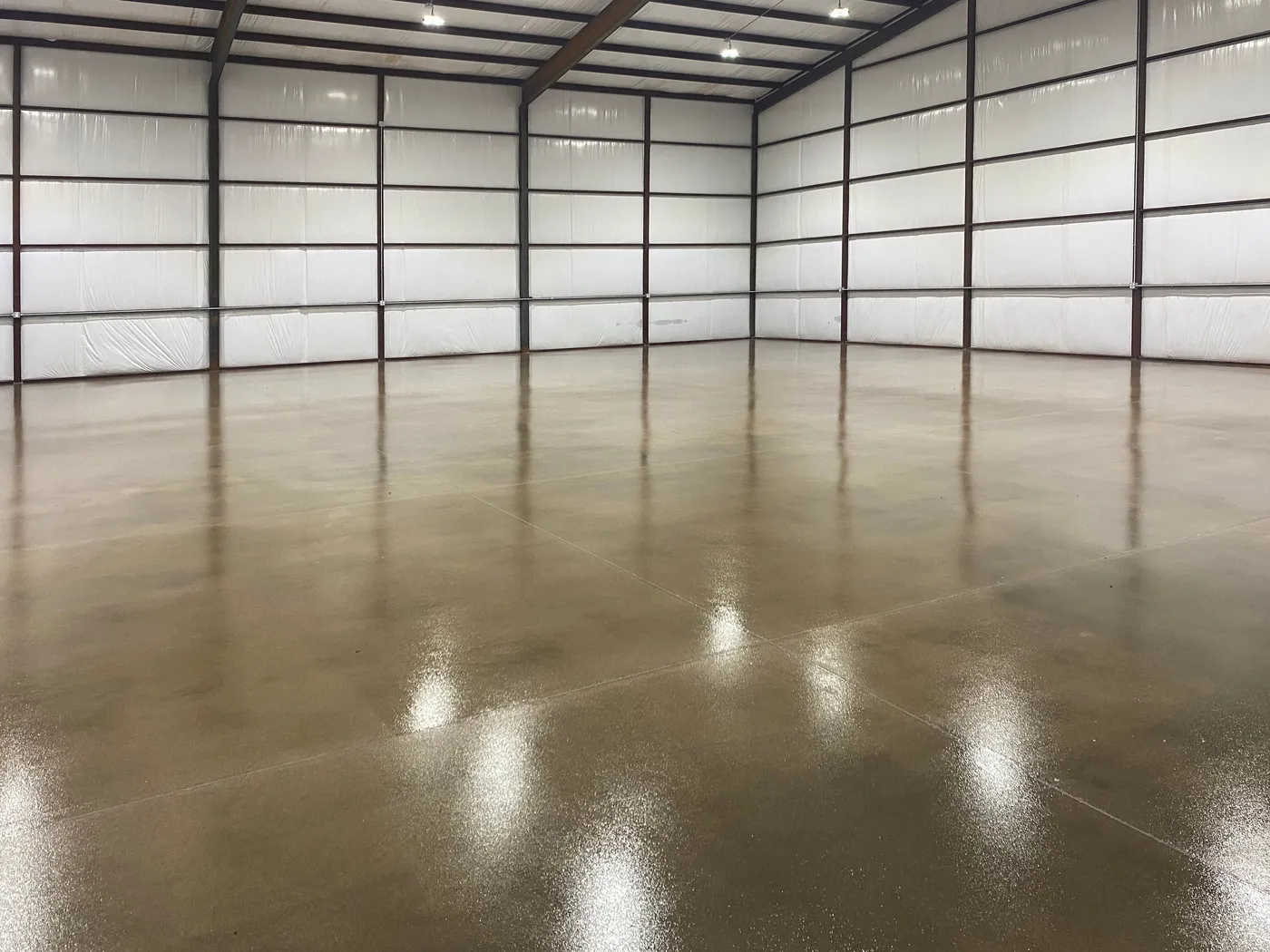
What are the commercial floor coating options for a Tampa Bay business?
A Tampa Bay business has four main options. They are epoxy systems, urethane or polyaspartic topcoats over an epoxy base, grind and seal, and polished concrete. Epoxy builds thickness for warehouses. Polyaspartic and urethane topcoats add UV and chemical resistance and cut downtime. Grind and seal is the budget finish. Polished concrete is the long-life showroom floor.
We install epoxy systems, polyaspartic and urethane topcoats, and grind and seal floors for businesses across Pinellas, Hillsborough and Pasco counties and the city of Sarasota. Polished concrete is covered here so you can compare it fairly. The right choice depends on what rolls, spills and walks across the floor. Our commercial flooring systems page covers what we install. This guide covers how to choose.
Which coating systems do commercial floors use?
Commercial floors use four families of finish. Epoxy is a thick resin coating that bonds to ground concrete. Polyaspartic and urethane are thinner, faster-curing topcoats that go over epoxy or straight onto concrete. Grind and seal is diamond grinding followed by a clear sealer. Polished concrete is the slab itself, refined with finer and finer diamonds until it shines.
Sherwin-Williams reports most professional resin floors are installed at 20 to 250 mils. It adds that facilities with forklifts often standardize on quarter-inch aggregate-filled epoxy. Prosoco notes epoxy resists oil, solvents and acids but traps moisture, so it needs a dry slab. That is why we test every slab for moisture before quoting.
Polyaspartic and urethane topcoats solve epoxy’s two weak spots. Prosoco describes polyaspartic as built for fast recoat windows and short return-to-service times. It also notes strong resistance to yellowing under long sun exposure. Concrete Network lists polyurethane sealers as nearly twice as thick as acrylics. Their finish is chemical- and abrasion-resistant and does not yellow.
Grind and seal skips the resin build. Niagara Machine describes it as one or two metal-bond grinding steps, a cleaning, then two coats of sealer. Polished concrete goes further. Bartell Global counts an average of 6 to 7 passes, sometimes 10, plus a densifier that hardens the surface. Our grind and seal concrete floors page explains where that budget finish fits.
How do you match a floor to the business?
Match the floor to the worst thing it faces. Retail and showrooms need looks and easy cleaning. Restaurant kitchens need heat, grease and hot-water resistance. Warehouses need thickness and impact strength. Medical spaces need a floor with no grout lines that survives disinfectants. Breweries need acid and thermal-shock resistance. Each of those points to a different system.
| Business use | Best-fit system | Why | Typical downtime |
|---|---|---|---|
| Retail floor | Polished concrete or grind and seal | Sweeping and damp mopping upkeep; never needs wax | Phased after hours |
| Showroom | Polished concrete, flake or metallic epoxy with clear topcoat | High-gloss look; flake hides scuffs | 1–3 days by system |
| Restaurant back of house | Urethane cement or epoxy with urethane topcoat | Heat, grease and hot-water washdowns | 1–3 days |
| Warehouse | Thick epoxy or aggregate-filled system with polyaspartic topcoat | Forklifts, pallet drops, abrasion | 2–5 days |
| Medical office | Epoxy with urethane topcoat and cove base | No grout lines; resists disinfectants | 1–3 days |
| Brewery or taproom | Urethane cement in the brewhouse, sealed or coated concrete in the taproom | Hot wort, CIP chemicals, acids | 2–4 days |
Retail floors favor polished concrete because upkeep is simple. National Concrete Polishing notes routine sweeping and occasional damp mopping keep the surface looking professional. It puts the lifespan past 20 years. HomeGuide adds that a low-sheen polish works well in retail, while high gloss is popular for showrooms.
Kitchens and breweries are the outliers. PennCoat describes urethane cement floors as handling extremes from minus 100 to 220 degrees. They resist oils, heavy greases and food acids. They also shrug off the thermal shock that damages standard epoxy. If your back of house needs that heavier system, we say so at the site visit.
Medical offices want a continuous floor. Sherwin-Williams describes resinous floors with almost no grout lines or seams and an integral cove base option. Its topcoats resist disinfectants and Betadine stains. That is a coated epoxy or urethane system, not polished concrete. Sherwin-Williams notes polished concrete is porous and not chemical resistant.
How much downtime does each system need?
Downtime runs from hours to a week. Galaxy Concrete Coatings puts polyaspartic at 4 to 6 hours to walk on and 24 to 48 hours for vehicles. Epoxy needs 24 or more hours to walk on and 7 or more days for a full cure. Grind and seal and polished concrete can be phased by section.
Florida humidity stretches those numbers. Galaxy notes humidity above 75 percent adds 2 to 4 hours to each polyaspartic curing stage. HomeGuide says epoxy should only go down between 60 and 85 degrees at under 85 percent humidity. In a Tampa Bay summer that means early starts and a schedule built around the forecast.
For a business that cannot close, sequence matters more than cure time. We grind and coat in zones and keep dust controlled. Finished sections go back into service while the next one cures. Westcoat calls its grind and seal a fast-turnaround system for exactly this reason.
Which floors resist chemicals and hot water?
Coated floors resist chemicals; bare polished concrete does not. Prosoco says epoxy forms a hard barrier against oil, solvents and acids. Concrete Network rates polyurethane as chemical- and abrasion-resistant and non-yellowing. Sherwin-Williams states polished concrete is stain resistant but not chemical resistant. For kitchens and breweries, PennCoat’s urethane cement handles food acids and hot washdowns that crack standard epoxy.
A polyaspartic topcoat adds a second line of defense. A polyaspartic maker’s technical data sheet lists ASTM D1308 results for common automotive fluids. Gasoline, brake fluid, antifreeze, transmission fluid and power steering fluid all showed no effect. That matters for auto shops, dealership service bays and any floor where fluids drip. Our industrial coating systems pair a thick base with a chemical-resistant top.
How do you keep a commercial floor from being slippery?
Texture in the topcoat is the answer. HomeGuide notes glossy epoxy can become slippery when wet, and that polished concrete gets slippery when wet like tile. Peckham Coatings says flake systems can carry added aggregate in the topcoat to meet slip standards. Epoxy Plus notes full-broadcast flake is less slippery than a smooth resin floor.
We build slip resistance into the broadcast. A full flake broadcast leaves texture on its own. For wet areas we add anti-slip grit to the final coat. Angi lists outdoor polished concrete with a slip-resistant finish as its own category. Slip-resistance requirements vary by use, so check with the county on any code question.
What do commercial floor coatings cost per square foot?
Published ranges cluster between $3 and $12 per square foot for most commercial floors. HomeGuide lists epoxy at $4 to $10 and polyaspartic at $5 to $12 per square foot installed. Angi puts commercial polished concrete at $5 to $12. Bob Vila lists sealed concrete at $0.85 to $1.60 over its $2 to $8 standard-job range.
| System | Published range | Source |
|---|---|---|
| Epoxy floor coating | $4–$10 per sq ft | HomeGuide |
| Epoxy floor coating | $2–$12 per sq ft | Angi |
| Polyaspartic floor coating | $5–$12 per sq ft | HomeGuide |
| Epoxy or urethane topcoat over polished concrete | $4–$9 per sq ft add-on | Angi |
| Sealed concrete (grind and seal) | $0.85–$1.60 per sq ft over a $2–$8 base | Bob Vila |
| Polished concrete, commercial | $5–$12 per sq ft | Angi |
| Polished concrete, basic | $3–$12 per sq ft | HomeGuide |
| Polished concrete, over 5,000 sq ft | $3–$6 per sq ft | HomeGuide |
Size and prep set where you land in those ranges. HomeGuide notes polished floors over 5,000 square feet can drop to $3 to $6 per square foot. Spaces under 1,000 square feet carry premium pricing. Angi lists removing old coatings at $1 to $3 per square foot and moisture mitigation at $2 to $6. A real quote needs an on-site look at the slab, the drains and the traffic.
For deeper cost detail by building type, see our post on commercial epoxy flooring in Tampa Bay. Our guide to warehouse epoxy flooring cost in Florida covers the heavy-traffic side.
Ready to match a system to your space? Request a free on-site quote from our commercial floor coating page or call (727) 423-5985. We test the slab, map the traffic pattern with you and price the system that fits your floor’s work.